Example 3: time evolution of a polycristalline microstructures composed of 30 and 102 grains
Files
- 30 grains
- Comprehensive test file (2D): main.cpp
- Comprehensive test file (3D): main.cpp
- 2D Reference results for comparison (regression test) (N=32, t=0.2): time_specialized.csv
- 2D Reference results for comparison (N=128, t=25): time_specialized.csv
- 3D Reference results for comparison (N=128, t=25): time_specialized.csv
- 102 grains
- Comprehensive test file (2D): main.cpp, run with the seed file of 102 grains provided in the test directory:
-s <path>/initial-grain-102.txt
- Comprehensive test file (2D): main.cpp, run with the seed file of 102 grains provided in the test directory:
- Variants with adaptive mesh refinement (partitioned scheme: one problem per grain, the other grains being auxiliary variables, one AMR object per problem)
- 2D: main.cpp
- 3D: main.cpp
- See the Adaptive Mesh Refinement page of the user manual.
Statement of the problem
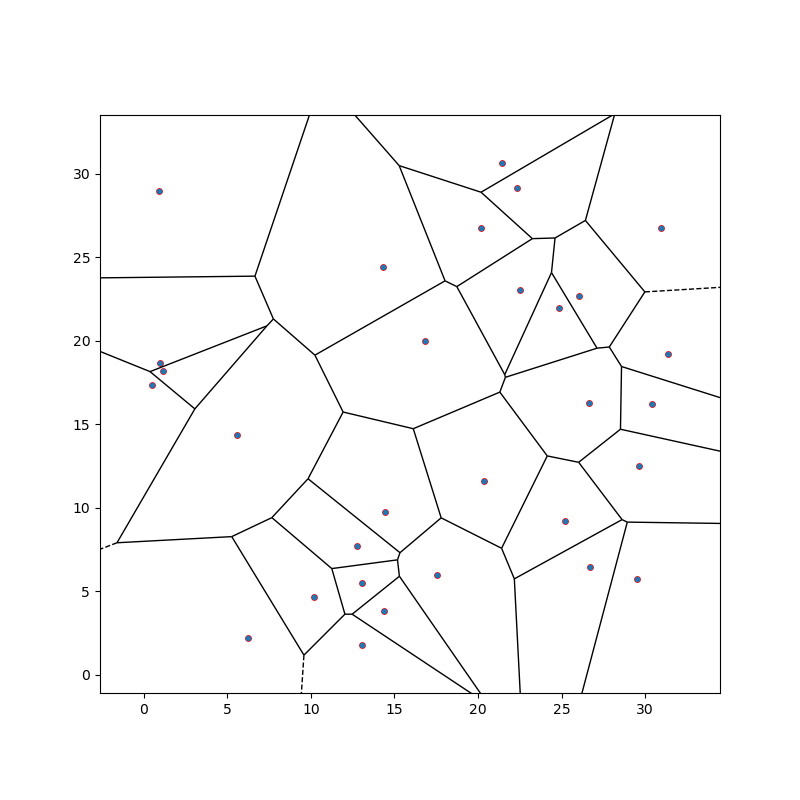
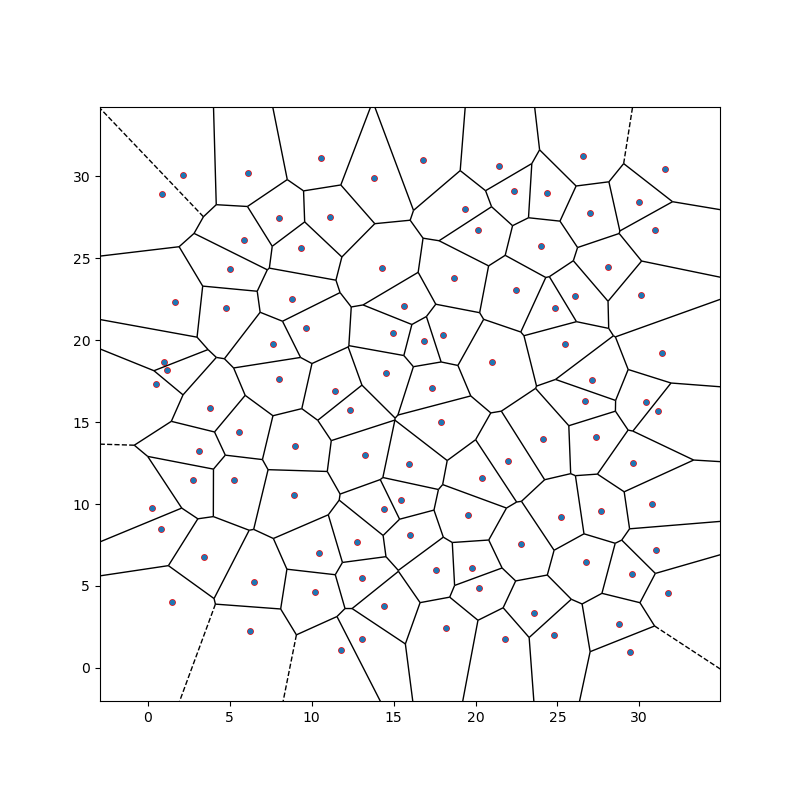
This test extends to 30 and 102 grains the one presented in 1 concerning the time evolution of a polycrystalline microstructure.
Allen-Cahn equations are solved in a square using an implicit monolithic algorithm.
where the free energy density is defined by:
Hereabove, corresponds to the number of grains.
Initial condition
The Voronoi-based initialization is generated using the Voro++ library2, from a file of seeds (one grain per line, option -s of the test): SLOTH must therefore be built with Voro++ (--voro option of envSloth.sh, or +voro variant of the Spack package).
Parameters used for the test
| Description | Symbol | Value |
|---|---|---|
| mobility coefficients | ||
| energy gradient coefficients |
Boundary conditions
Periodic boundary conditions are prescribed on boundary of the domain.
Numerical scheme
- Time integration: Euler Implicit over the interval with a time-step .
- Spatial discretization for convergence analysis: uniform grid with nodes in each spatial direction, with finite elements
- LBFGS solver: relative tolerance , absolute tolerance
Results
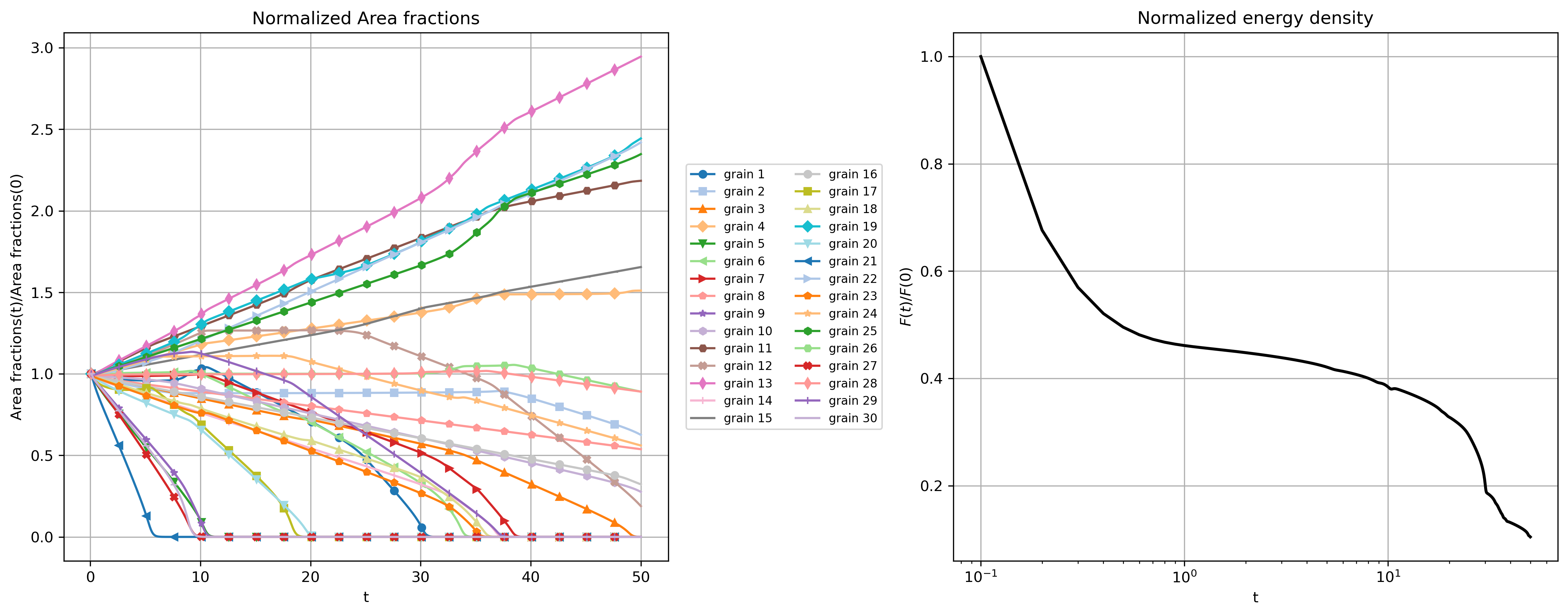
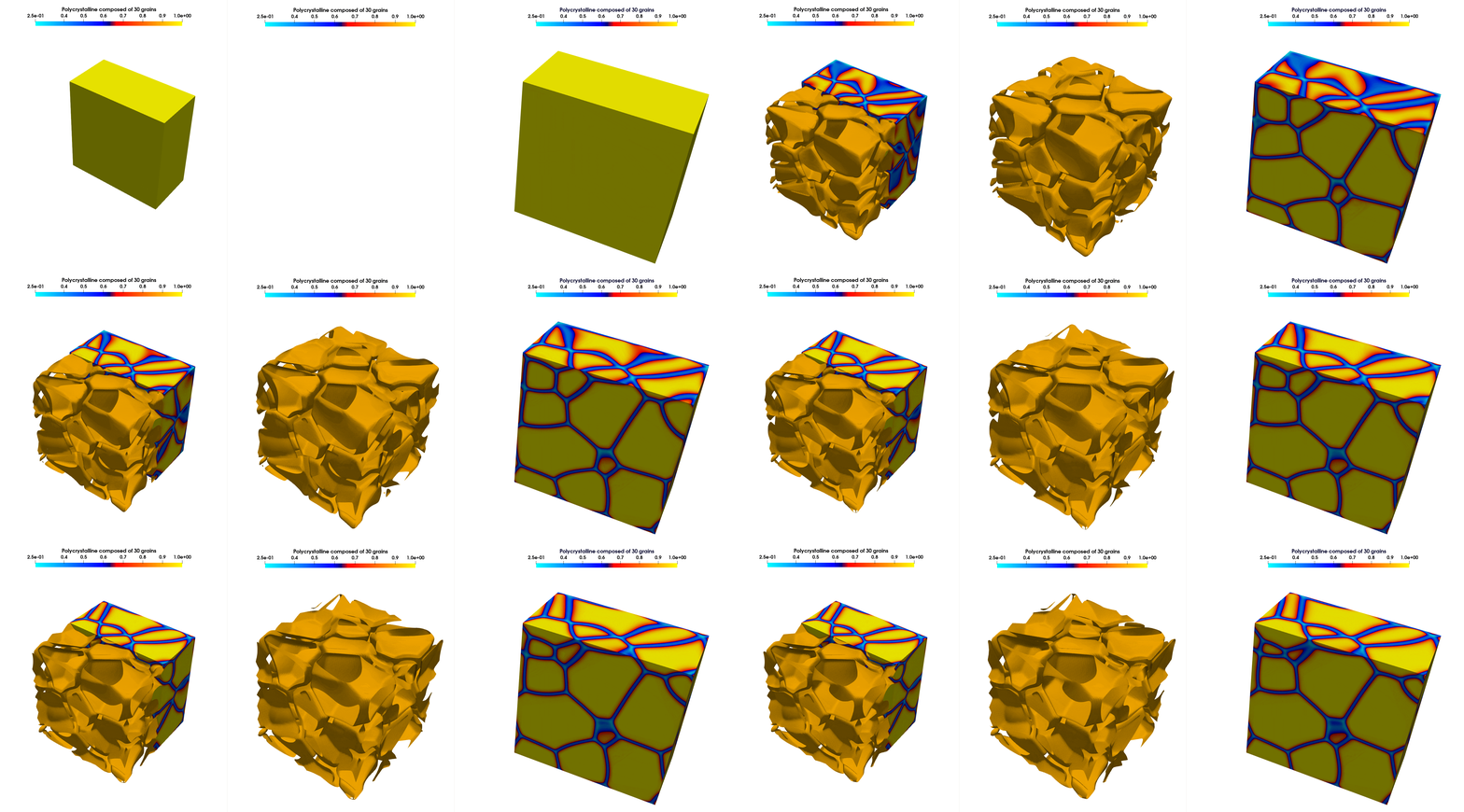
Figure 3 shows the time evolution of the normalized area and energy density for the polycrystalline microstructure composed of 30 grains. As shown on Figure 4, smaller grains tend to disappear, while larger grains grow. Figure 5 shows a 3D extension of the time evolution of the polycrystalline microstructure composed of 30 grains.
Figure 6 shows the time evolution of a polycrystalline microstructure composed of 102 grains.